A Different Economy
Total Conquest III changes how towns make money and what you build in them. Everything here applies to the human player; AI factions build and recruit as in the base game.
- Farming is poorer. Base fertility is lowered across the map. Towns grow at about their old pace, but farm income is gone.
- Towns earn from a focus. A town's Focus gives it a specialisation and a flat income every turn. This is your main source of money.
- Trade goods matter more. The resources in a province feed several bonuses at once, so the same good can appear more than once in a town's income.
- Harbours are a major investment. Every faction can now build ports, shipwrights and dockyards, and each one is a heavy draw on the treasury.
- Status matters. Each town is a Subject, an Ally or a Citizen, and that changes tax, order and loyalty.
- Edicts are decrees. Quick, cheap orders for one town, built like buildings.
- Debt is allowed. Decisions that cost money are paid even if they put you into debt.
- Recruitment differs from faction to faction. Read your faction's journey to learn how its armies are raised.
Reading the Building List
The building browser is sorted into sections, and two prefixes tell you what an entry is:
- Focus: the entry takes up one of the town's focus slots, for example Focus: Trade Hub or Focus: Military Centre.
- Edict: a decree for this town, for example Edict: Tax Relief.
Many entries are orders. They take one turn and turn into something else: Focus: Invest in Agriculture becomes Focus: Agricultural Development, a muster order becomes troops. Others are markers that show a town's state: its region, its status, its discontent. You do not build them; they come and go with the town's situation.
Keep Auto-Construction Off
The automatic governor was made for the base game. It does not understand orders, focuses or decrees, and it treats them like ordinary buildings. Left alone it can:
- queue Remove Policy, which is free and wipes every focus in the town, military buildings included;
- queue Abandon Settlement, which hands the town to the rebels;
- revoke a town's status, which leaves it seething for years and frightens your other citizens;
- spend your treasury on musters, edicts and costly harbours you did not want.

Focus: Agriculture
40,000, one turn, from village size. The best focus for small rural towns.
- A flat income every turn, highest in small towns.
- +3 farming, +2 more with grain; +1% growth.
- +10% trade income each with wine or olive oil.
| Town size | Income per turn |
|---|---|
| Village or town | 900 |
| Large town | 750 |
| City | 600 |
| Large city | 450 |
| Huge city | 300 |
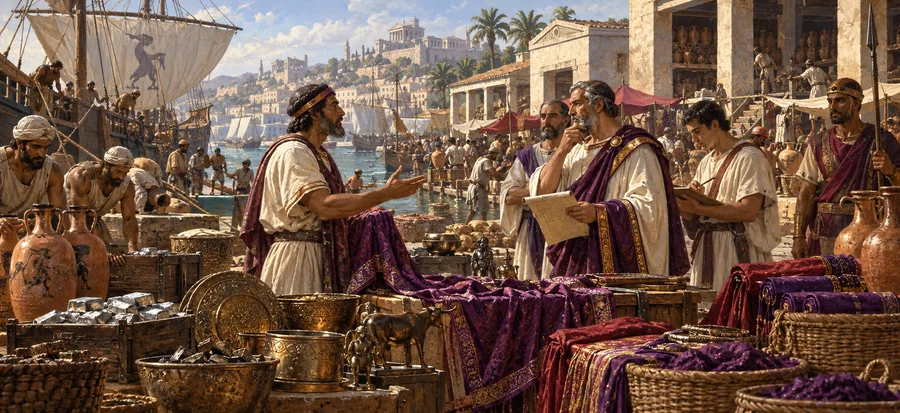
Focus: Trade
40,000, one turn. The best focus for big cities and ports.
- A flat income every turn that grows with the town, plus 150 / 300 / 450 more with a port / shipwright / dockyard.
- +40% trade income and +3% tax; more again with luxury goods such as silk, incense or purple dye.
- One extra trade fleet.
| Town size | Income per turn |
|---|---|
| Village | 150 |
| Town | 300 |
| Large town | 450 |
| City | 600 |
| Large city | 750 |
| Huge city | 900 |
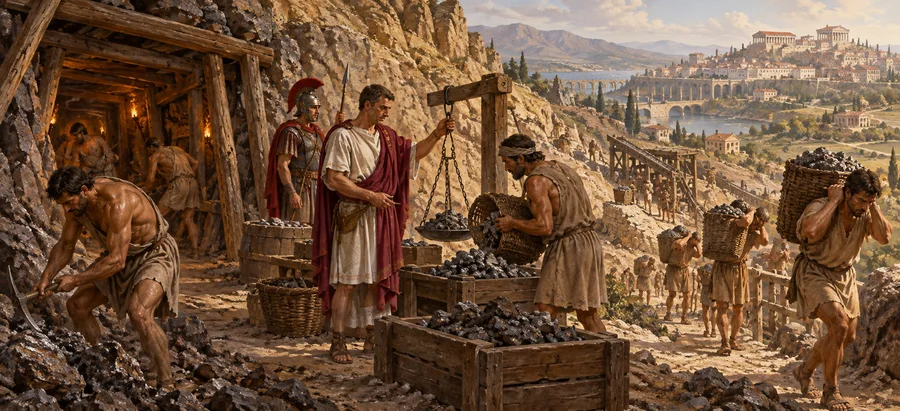
Focus: Mining
6,000, one turn, and the town needs a mine.
- A large boost to mining output: an ordinary mine gives 4, this focus adds 30.
- +20% trade income with gold or silver, +10% with iron, copper, tin or lead.
- Slightly slower growth, and an upkeep in towns (150 to 350 a turn by size).
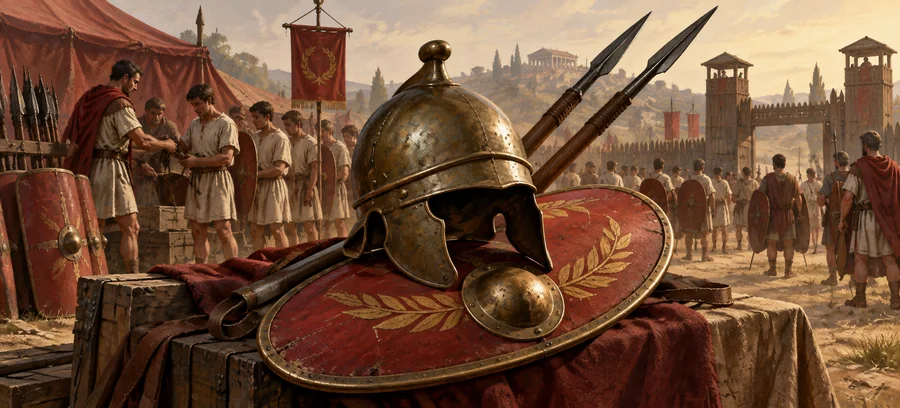
Focus: Recruitment
10,000, one turn. This is your military building, and it upgrades in place:
| Stage | Cost | Where |
|---|---|---|
| Recruitment Centre | 10,000 | Any town |
| Military Centre | 30,000 | Cities. Your capital: from large town |
| Regional Military Headquarters | 60,000 | Large cities. Your capital: from city |
The whole ladder holds one focus slot, has an upkeep that grows with the town, and costs some public order. Each faction calls it something different, such as a Chariot Yard or a Royal Military District, and uses it differently: see the journeys.
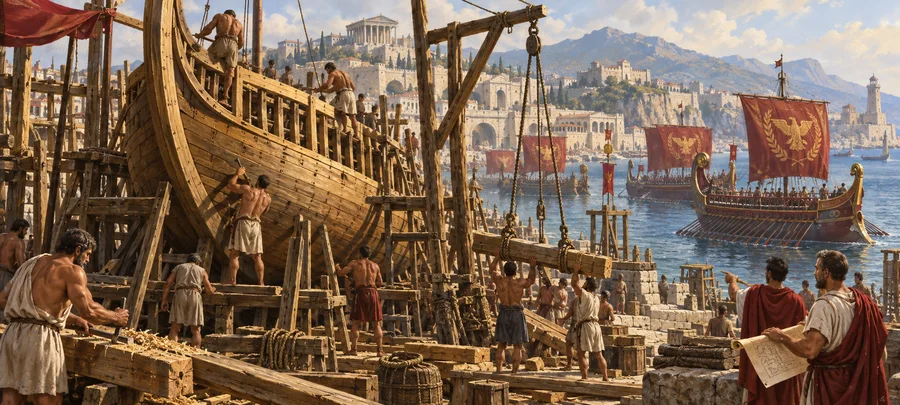
Focus: Naval
8,000, one turn, and the town needs a port. It lets you build warships: bigger ships with a shipwright and a dockyard. +10% trade income, and an upkeep.
Harbours are now open to every faction, and each step is a serious investment:
| Harbour | Cost |
|---|---|
| Port | 30,000 |
| Shipwright | 45,000 |
| Dockyard | 65,000 |
A harbour also raises the income of a Trade focus in the same town.
Focus Slots
Each town has room for a limited number of focuses:
| Town | Focus slots | If it is your capital |
|---|---|---|
| Village, town, large town | 1 | 2 |
| City or larger | 2 | 3 |
- You cannot take the same focus twice in one town.
- Remove Policy is free and takes one turn, but it clears all focuses in the town at once, including military buildings.
- Focuses are lost when a town is captured.
Subjects, Allies and Citizens
Every town you own has a status. Your starting towns are Citizens; conquests start as Subjects.
| Status | Tax | Public order | Law | Other | Upkeep |
|---|---|---|---|---|---|
| Subject | +50% | -30% | +1 | None | |
| Allied | +15% | -5% | +1 | +20% trade income | 200 |
| Citizen | -70% | +10% | +4 | Musters draw your own troops here | 400 |
A town climbs one step at a time: Grant Allied Status turns a Subject into an Ally for 10,000. Each faction gives these orders its own names, such as Make a Client Kingdom.
Subjects pay the most and obey the least: good for rich, quiet conquests, dangerous for restless ones. Allies are the middle road: steadier, still profitable and good for trade.
Citizenship
Citizens are the heart of your realm. Your starting towns are citizens, and you can make more.
How to grant it: the town must already be an Ally and at least a town in size. Grant Citizenship costs 30,000 and takes one turn. Each culture has its own name for it, such as Bind as Sworn Kin for the Britons.
What a citizen town gives you:
- Order and law: +10% public order and +4 law. Citizen towns rarely riot.
- Loyalty: citizens are the backbone of your musters. Where a faction raises troops by region, citizen towns send your own soldiers rather than local levies.
- Protection: citizens cannot be squeezed. Harsh edicts such as Extort or Take Hostages are for subjects and allies only.
What it costs you: -70% tax and an upkeep of 400 a turn. Citizenship is an investment in stability, not in income.
When to grant it: wait until your culture has taken hold in the town. Making strangers into citizens too soon upsets your established citizens (Spoiler mode explains how).
Each citizenship revoked in the same turn adds unease to every remaining citizen town, counted up to four times. Revoking several towns at once can throw your whole heartland into unrest.
For the Romans, citizenship is also politics. The balance of subjects, allies and citizens in Italy decides whether the Italian allies take up arms in the Social War, and the Lex Julia can make many towns citizens at once. When a Roman player retakes a former Roman home town, it becomes a citizen town again.
Culture
Every town has a culture, shown as a building in its list. At the start of the campaign each town has its native culture or cultures (Celtic in Britain, Greek in Greece, Punic in Africa), some strong, some faint.
When you own a town, your own culture slowly takes root beside them. Each turn the town gains influence:
| Source | Influence per turn |
|---|---|
| Subject town | +1 |
| Allied town | +2 |
| Citizen town | +3 |
| Edict: Public Schools | +2 more |
| Edict: Latin Colonies (Rome) | +5 more |
| Edict: Honour Local Customs | -1 |
Your culture appears at 80 influence and grows through five levels: Residual (80), Minor (160), Moderate (280), Strong (320) and Dominant (360). A subject town takes 80 turns to show any trace of you; a citizen town with Public Schools needs about 16. Capturing a town resets its influence to zero, and the native cultures never fade: yours grows beside them.
Your own culture rewards you, and each people in its own way. At its strongest:
| Your culture | Dominant in a town you own |
|---|---|
| Latin (Rome) | +15% law, +10% public order, +20% trade, +0.5% growth |
| Hellenistic (Macedon, Seleucids, Ptolemies) | +15% tax, +15% law, +20% trade, +0.5% growth |
| Persian (Parthia) | +15% tax, +15% law, +20% trade, +0.5% growth |
| Punic (Carthage) | +40% trade, +15% tax, +10% public order, +0.5% growth |
| Celtic (Gauls, Britons) | +15% public order, +1% growth, +1 farming |
Living With Other Cultures
The native cultures of a conquered town keep working on you, and what they do depends on who you are. Rome, Macedon, the Seleucids, the Ptolemies, Parthia and Carthage count as civilised peoples; the Gauls and the Britons count as barbarian ones.
- Civilised rulers profit from the old cultures of the Mediterranean and the East: Greek, Hellenistic, Punic, Egyptian and Jewish towns bring extra trade. The tribes are another matter: Celtic, Germanic and steppe towns resist them with lost law and order.
- Barbarian rulers get on well with other tribes: Celtic, Germanic, Iberian and steppe towns are calmer under them. The great cities are hard to hold: Greek, Hellenistic, Latin, Punic and Egyptian towns bring penalties to law, order and trade.
At full strength a foreign culture matters as much as your own:
| Native culture (Dominant) | Under a civilised ruler | Under a barbarian ruler |
|---|---|---|
| Greek | +20% trade, +5% public order | -20% public order, -15% law, -10% trade |
| Hellenistic | +20% trade, +5% tax | -15% public order, -15% law, -10% trade |
| Latin | +20% trade, +0.5% growth | -15% law, -15% public order, -0.5% growth |
| Punic | +30% trade, +5% public order | -40% trade, -15% public order, -5% law |
| Egyptian | +20% trade, -10% public order | -30% trade, -20% public order, -5% law |
| Persian | +20% trade, +5% law | -15% public order, -15% law, -10% trade |
| Celtic | -15% law, -15% public order, -10% tax | +5% public order, +0.5% growth |
| Germanic | -15% law, -15% public order, -20% trade | +10% public order, +0.5% growth |
| Iberian | +20% trade, -10% public order, -5% law | +10% public order, +10% trade |
Citizens Resent Newcomers
Granting citizenship too early upsets your established citizens. If your culture has not yet taken hold in the new citizen town, some of your old citizen towns may grow discontented:
| Stage | Law | Tax | Public order |
|---|---|---|---|
| Unease | -1 | -5% | -5% |
| Resentment | -2 | -10% | -10% |
| Unrest | -3 | -15% | -15% |
| Crisis | -4 | -20% | -20% |
Discontent falls by itself, one step every few turns. Edicts and pacification do not cure it: only time does. For Romans the culture rule means at least Moderate Latin Influence.
Edicts
Edicts are decrees for one town. Each costs money, takes one turn and lasts until you demolish it or lose the town. They have no upkeep: the price is in their trade-off. A town can hold only one edict of each kind (finance, order, economy, culture, military, civic). Each faction has at most ten.
Every playable faction has the six common edicts:
 Tax Relief5,000 | -25% tax, +25% public order
 Census and Assessment8,000 | +15% tax, +1 law, -5% order
 Market Privileges10,000 | +30% trade income
 Public Schools8,000 | culture spreads faster, -10% tax
 Honour Local Customs5,000 | +10% order, -5% tax, culture spreads slower
 Sanitation Measures10,000 | +2 health, -15% tax
Your Own Decrees
Most factions add three or four edicts of their own on top of the common six: Rome can Extort its subjects or give Bread and Games, the Britons take hostages and hold druidic assemblies, the Ptolemies run a royal grain monopoly. Each faction journey lists its own.
Abandon Settlement
Every faction can give up a town it no longer wants. It is free and takes one turn. When it completes, the town revolts to the rebels; if it is under siege, the revolt waits until the siege ends. You get nothing back.
Emergency Coinage
If your treasury stays below zero for several turns, your moneyers may offer to strike lighter coin. Accepting refills the treasury to at least 100,000, but every town you own then pays for it:
| Issues | Marker | Penalties in every town |
|---|---|---|
| 1 | Light Coinage | -10% tax |
| 2 | Distrusted Coinage | -10% tax, -10% trade income |
| 3 | Discredited Coinage | -10% tax, -10% trade, -10% public order |
Each issue restarts a 50-turn recovery, and there is no fourth. When fifty turns pass without another issue, all penalties vanish at once. New conquests take on your current penalty.
Regions and Landscapes
The map is divided into 18 regions, from Italia and Gallia to Persia and the Eastern Lands. Every town carries a permanent landscape building naming its region; it gives a growth bonus that makes up for the lower fertility. On the campaign map each region's emblem is tinted its own colour, so you can see where one region ends.
Regions decide where musters and levies draw their troops, and where many crises strike.
2 chapters are sealed. They explain emergency coinage and the anger of established citizens in detail.
Field notes
- Turn auto-construction off in every settlement, and keep it off.
- Use Agriculture in villages and towns and Trade in big cities with harbours. In a two-slot city the incomes stack.
- Never use Remove Policy to swap one focus: it tears down your military buildings too.
- Leave conquests as Subjects while they are profitable and quiet; raise them to Allied when order becomes the problem.
- Never revoke a status to squeeze a town. The anger lasts for years and spreads to your other citizens.
- Edicts are cheap fixes: enact one for a crisis, demolish it when the crisis is over.